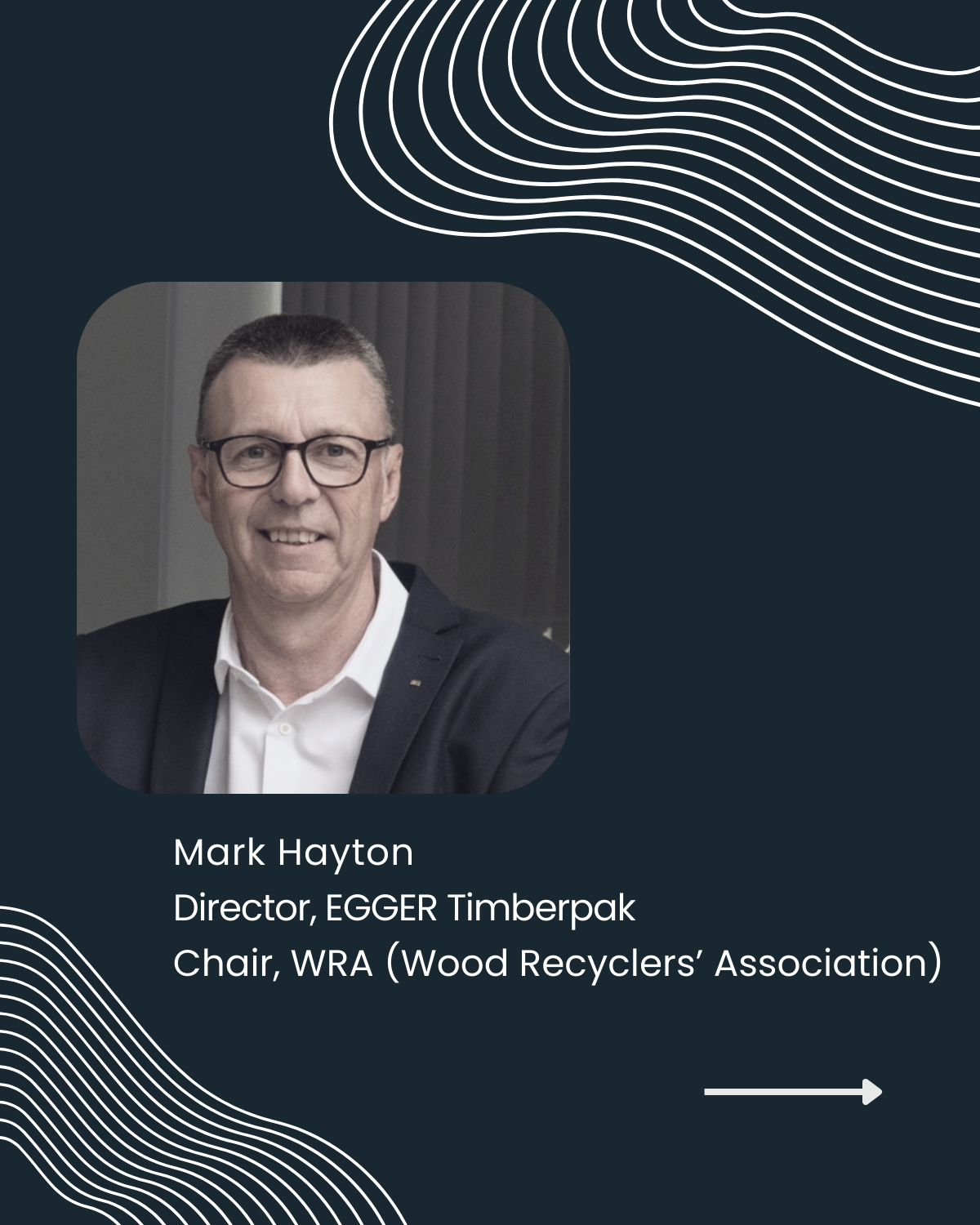
Some people may not be aware that your career path began on the tools as an electrician before moving into the panel board industry and ultimately leading Timberpak. How did that hands-on start shape the way you approach leadership and operational decision-making today?
To be a true leader I believe you need to understand what it means to have a leader, what’s expected, required and desired from those you lead. Starting at the bottom gave me a real understanding of all the steps in my career path.
You’ve helped grow Timberpak from a single site handling around 20,000 tonnes of waste wood into a four-site operation processing hundreds of thousands of tonnes annually. What were the key milestones that made that growth possible?
Demand and growth from our particle board manufacturing plants in England and Scotland meant that the demand for waste wood increased, and the majority of that came from Timberpak.
Investment in more recycling brings with it the need for more wood. It has always been EGGER’s approach to stay close to our customers and this is how we operate at Timberpak.
Waste wood sits right at the heart of the circular economy. What’s the biggest misconception people still have about the value of recycled wood?
That’s a good question. The value. Although it is waste it still has a cost attached to turn it into material that can be recycled or recovered. The cost of this depends on the amount of work required at the time of disposal. If it is kept in the streams that add the most benefit, then the cost is lower. Segregation of the higher and lower grades of wood is key, for example keeping MDF separate from solid wood and MFC.
Demand for sustainable materials is rising rapidly. Do you believe the UK has enough recoverable wood in the system to meet future demand?
In the UK we have approximately 4.5M tonnes a year of waste wood. We currently recycle or reuse between 1-1.5M tonnes. It is a matter of how we prioritise reuse and recycling over and above recovery.
We must ensure we use the material in the most beneficial way, with it also at some point re-entering the waste wood market and thus the circular economy continues.
As Chair of the Wood Recyclers’ Association, you’ve taken on the role at a pivotal time for the sector. What are the top priorities you want the WRA to focus on over the coming months and years?
My priorities are very clear. We have a home for all the UK’s waste wood now, but it’s the order or priority of how this wood is used that is the most important thing.
We need to consider the Waste Hierarchy when looking at waste wood and always try to promote reuse and recycling in the first instance over energy recovery. The more wood we can reuse and recycle the more wood we make available. Biomass plays an important part in this but it should be the last alternative. We shouldn’t just burn wood if we can give it another life first.
The wood recycling sector often operates behind the scenes. Do you think the industry gets the recognition it deserves?
No, I don’t think it does. Like a lot of other industries, the public doesn’t understand what happens behind the scenes.
Waste wood recycling plays a vital part in the UK economy. It is there in wood products that surround us in our daily life, our homes, our offices, our schools, hospitals, shops, and hotels. What can’t be recycled is used for biomass energy. Nothing is wasted.
Policy often shapes how waste resources are used. Where do you think government is getting it right and where is the sector still being held back?
The WRA is calling for the wood packaging recycling target to be raised to 55% as soon as possible, as the current targets threaten the wood packaging recycling market and key end markets such as panel board and animal bedding. Because these targets influence the level of PRN support for recycling, they must be high enough to incentivise recycling and keep wood packaging aligned with the waste hierarchy.
If targets remain too low, the effective system that allocates waste wood to the right end users will be undermined, UK recycling rates will fall, and valuable material that could be reused or recycled may instead be diverted to energy recovery.
Technology is transforming recycling operations. What innovations do you think will have the biggest impact on the wood recycling industry over the next decade?
At the moment, recycling waste wood is getting harder. We struggle to persuade people to segregate at source and deliver clean wood to the particle board industry and the lower grade to biomass. People just treat it all the same.
For this reason, the panel board sector has had to install technology to clean up the waste wood stream. This means more optical sorting, robotic sorting or a mixture of the two. Cleaning up the wood stream is a challenge but a necessity.
The wood recycling ecosystem involves waste producers, recyclers and manufacturers. Where do you think collaboration across the value chain still needs to improve?
More segregation could be achieved through the right policy interventions. Supply chain education to encourage the segregation of cleaner material would ensure that this is driven further up the waste hierarchy in line with the government’s circular economy ambitions, rather than sent to biomass.
What do you hope your contribution to the wood recycling industry will ultimately be remembered for?
Making people think about how to use waste wood in the best way as it is such a valuable resource. Don’t just burn it, reuse or recycle it first and give it at least one more lifecycle.