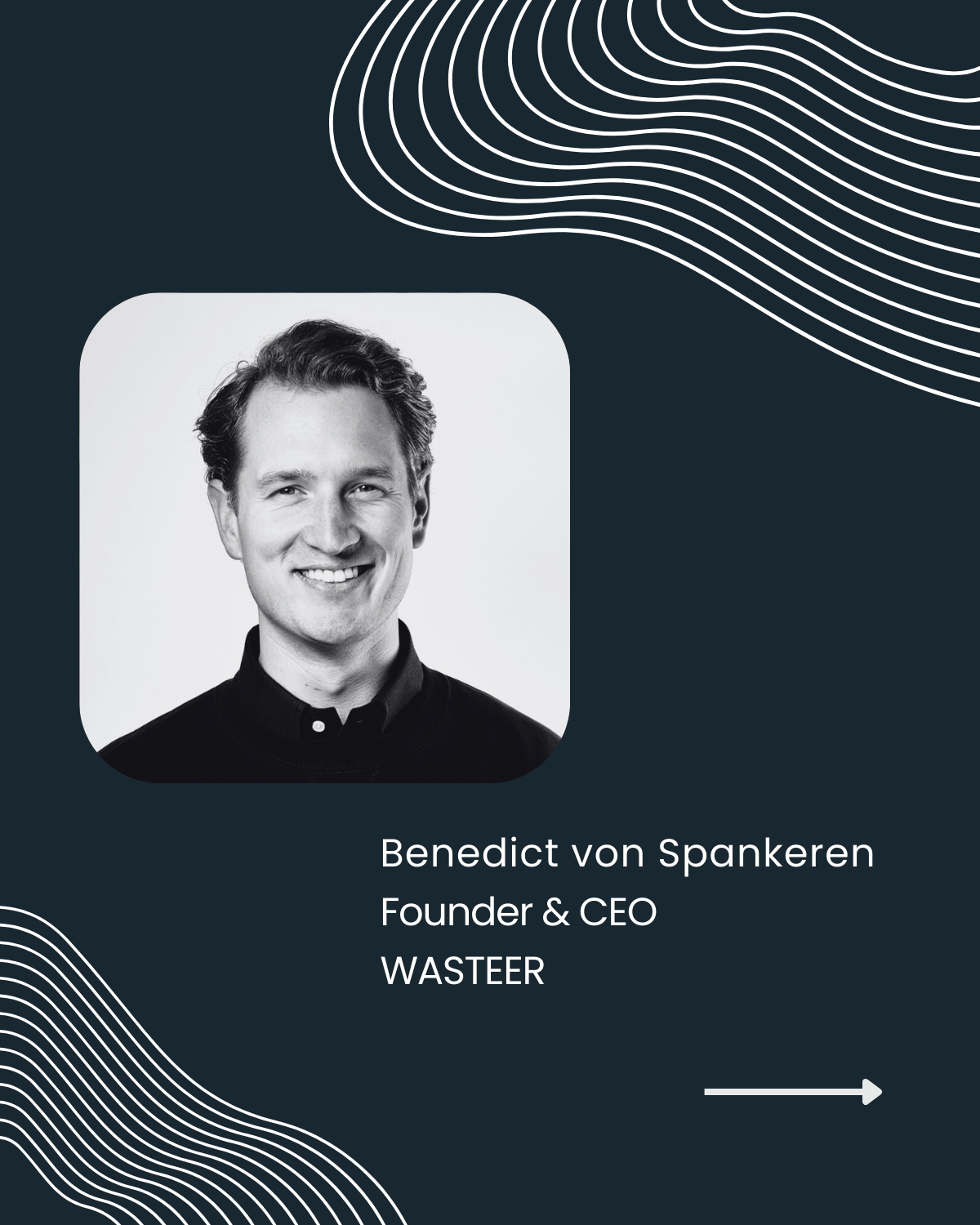
Your background suggests a long-standing fascination with transforming materials and systems. How did that personal mindset influence the original vision behind Wasteer?
My background made me obsessed with how systems behave when you change inputs, constraints, and incentives. Waste was fascinating because it’s a physical material flow, but also a systems problem: regulation, pricing, logistics, human behaviour, and plant operations.
We actually started with the idea of a waste trading platform. Very quickly we learned that access to waste wasn’t the bottleneck, quality and predictability were. You can’t trade what you can’t specify. So the vision evolved, before you optimise or “marketplace” anything, you need the missing layer, consistent, scalable insight into what’s actually in the waste.
That mindset also shaped how we build Wasteer, we don’t start with “cool tech.” We start with the operator’s day, uptime, safety, throughput, and compliance, and we stay flexible. Once you understand the real constraints on site, you realise the root problem isn’t trade, it’s understanding the input. Everything else follows from that.
What did you see inside the waste sector that convinced you it was both under-digitalised and ripe for entrepreneurial disruption?
When I first looked inside the sector, it was obvious it’s an industry that runs critical infrastructure incredibly well, but often with tools and processes that feel one or two decades behind. The “fax machine” stereotype exists for a reason, but the deeper point is, many core decisions still happen manually, based on experience, not on connected data.
What made it entrepreneurial is the combination of strong fundamentals, demand, long-lived assets, stable cash generation, with huge inefficiencies. At the same time, the sustainability leverage is enormous: if you improve sorting quality, reduce outages, or stabilise operations, the impact scales immediately.
So it’s ripe for disruption not because operators are doing a bad job, they’re not, but because the industry is now forced into transparency and optimisation by regulation and increasing waste complexity. Digitalisation becomes less of a “nice to have” and more of a requirement to stay competitive.
Wasteer positions data as the missing layer in waste treatment optimisation. Where do you see the biggest value leakage today across sorting, treatment and downstream recovery?
The biggest value leakage is fundamentally input uncertainty. Across sorting, EfW, and recovery, we often don’t truly know what’s coming in, in real time, at scale, with accountability.
That creates a cascade: sorting can’t optimise because it doesn’t know what to target; treatment plants run with more variability, higher risk of outages, and lower yield, downstream recovery gets contaminated streams and loses value.
Our view is simple. If you want to optimise outputs, energy, quality fractions, compliance, you have to understand the input first. That’s why Wasteer focuses not only on contaminant detection but also composition analysis and forecasting: making waste streams measurable so operators can steer processes and, over time, improve behaviour upstream.
Many operators already collect large volumes of operational data but struggle to act on it. Is the industry’s challenge technological, cultural, or economic?
It’s a mix, but I’d say it’s primarily technological and cultural, with economics shaping the speed.
Many plants already have a lot of data, but data alone doesn’t create value. First you need a clear problem definition. Then you discover the data is often messy, fragmented, and hard to link across systems. The real effort is frequently integration and cleaning before you ever get to “AI.”
Culturally, the sector is experienced and operationally excellent, and if something has worked for 20 years, change needs a strong reason. People also worry about accountability: when you introduce transparency, you change how performance is perceived.
So the winning approach isn’t “more dashboards.” It’s decision intelligence embedded into daily work, with clear ROI and minimal friction.
Where are investors still misunderstanding the opportunity in digital waste infrastructure and what metrics should they really be paying attention to?
Investors often underestimate how fast waste input is getting more complex and how much that translates into operational and regulatory risk. Treatment plants are increasingly handling the “rest of the rest,” and that creates cost, downtime, and compliance exposure.
They also sometimes frame this as “nice-to-have digitalisation.” In reality, European regulation is pushing traceability, CO₂ accounting, and documentation, so digital infrastructure becomes a way to solve today’s operational problems while also making plants future-proof.
The metrics that matter aren’t vanity KPIs. They’re operational and compliance outcomes: reduced unplanned downtime, fewer safety incidents, higher throughput, more stable energy yield, fewer exceedances, and measurable supplier quality improvements. If you can quantify those, you’re not selling software, you’re improving infrastructure performance.
How do you balance sustainability outcomes with commercial reality when working with operators under intense margin pressure and rising regulatory expectations?
My view is, sustainability needs to be economically durable. If it doesn’t save or make money, it’s the first thing that gets cut when budgets tighten.
With operators, we usually lead with what they care about every day: uptime, safety, throughput, and compliance. The advantage of our approach is that it improves those metrics, fewer outages, fewer damaging contaminants, better stability, and the sustainability outcome comes with it: less auxiliary fuel, fewer unnecessary logistics, and better recovery quality.
Right now, many customers don’t buy because of “sustainability” as a label. But they do buy outcomes that happen to be sustainable, and that’s how it becomes scalable.
To what extent can intelligent waste steering genuinely influence upstream behaviour of producers, municipalities, or consumers?
Yes, but in a very specific way. The strongest lever isn’t hoping consumers change because of end-of-pipe measurement. The strongest lever is making the market more transparent so accountability becomes possible.
Today the waste market is often opaque. Once you can measure what’s delivered, you can create feedback loops: suppliers become more careful, municipalities can enforce standards, and operators can implement fairer acceptance and pricing mechanisms.
Will this instantly change product design or consumer habits? Not directly. Those require regulation, education, and incentives like EPR. But transparency is a prerequisite, you can’t allocate responsibility without evidence. Intelligent steering provides that evidence and enables upstream change through contracts and incentives.
In your view, what separates waste companies that will become circular economy leaders from those that risk becoming stranded infrastructure assets?
Circular economy leaders will be the ones who can operate reliably while waste composition keeps changing and regulation keeps tightening. They’ll treat waste streams as something to measure, steer, and optimise, not just something to process.
They’ll invest in transparency, traceability, and quality control, and they’ll build feedback loops with suppliers and downstream partners. That makes them adaptable and investable.
The companies at risk of becoming stranded are those whose assets are rigid and whose business model depends on opacity: if they can’t quantify inputs, outputs, and impacts, they’ll struggle with compliance, financing, and competitiveness as the market shifts.
Innovation in waste management is often associated with new hardware or treatment technologies. Why do you believe data-driven decision intelligence represents the next major wave of innovation in the sector?
I agree innovation is often associated with new hardware, and hardware matters. But most facilities already have substantial physical infrastructure. The missing layer is the “analysis and decision layer” that tells you what’s happening, what will happen next, and what action to take.
Software moves faster than hardware, and it compounds: once you have consistent data about inputs and outcomes, you can improve processes continuously, connect systems, and eventually automate more intelligently.
So I see data-driven decision intelligence as the next wave because it unlocks value from the existing asset base, it becomes the brain that makes the muscles more effective, safer, and more compliant.
As Wasteer grows, how are you intentionally evolving your leadership style to move from founder-led execution to organisational leadership?
The transition I’m intentionally making is from being the person who solves problems to building an organisation that solves problems without me.
That means clear ownership and decision rights, pushing decisions to the people closest to the facts. It also means hiring strong leaders and giving them real space to run their areas, while I focus more on vision, strategic partnerships, and the highest-leverage customer relationships.
Practically, we’re building repeatable processes: how we ship product, how we integrate on site, how we learn from incidents, and how we prioritise. The goal is to stay fast and customer-close, but with an organisation that scales, where I’m not the bottleneck.