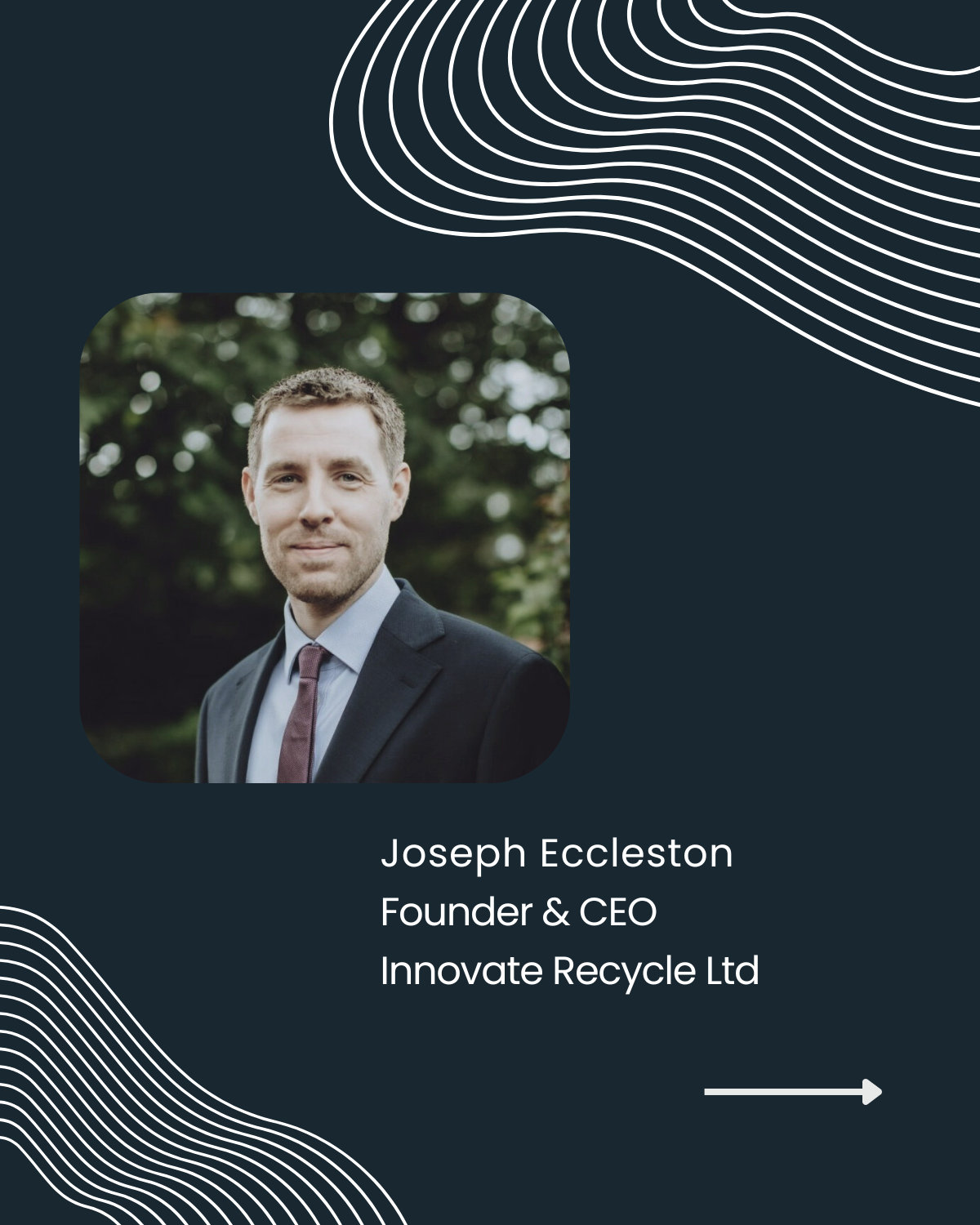
Before launching Innovate Recycle, what professional experiences shaped your perspective on waste infrastructure and at what point did you recognise carpet recycling as a systemic gap worth building a business around?
I grew up in a family carpet business and later took it over, so I’ve seen first-hand on shop floors, with fitting teams and in skip yards, just how routinely valuable materials were being landfilled or burned. Being that close to the day-to-day reality of the trade made the waste impossible to ignore, especially the sheer volume of polypropylene (PP) broadloom carpet in the UK market. That proximity to the problem is really what crystallised the opportunity for me.
The “gap” became obvious over time. Despite hundreds of thousands of tonnes of textile flooring waste arising each year in the UK, very little was truly recycled. Diversion gains were largely energy from waste, landfilled or downcycled. I reached a point where it felt clear that the sector needed at-volume, mechanical deconstruction infrastructure that could reclaim PP and calcium carbonate back into manufacturing, turning what had always been treated as an end-of-life liability into a domestic raw material supply.
The majority of UK carpet waste has historically gone to landfill or energy from waste. Why has true carpet recycling not scaled before and what has shifted commercially, technologically or regulatorily to make this moment viable?
Historically, three barriers really dominated. First, design and heterogeneity. Mixed fibre and backing constructions, along with various additives, made separation uneconomic, so “recovery” defaulted to incineration or equestrian surfaces, which is effectively downcycling. Second, there was weak pull for secondary polymers. Without consistent, high-purity outputs, manufacturers simply didn’t have the confidence to substitute recycled for virgin PP at scale. Third, the policy and cost signals weren’t aligned. In the absence of product-specific stewardship, such as EPR for carpets, landfill and incineration captured most tonnage, and producer-led efforts prioritised diversion over true recycling.
What’s changed is a combination of technology, market pull and policy direction. On the technology side, we now have proof at volume. Our patented mechanical deconstruction line, (the UK’s first to recycle PP carpets at volume)separates fibre and filler cleanly, producing pelletisable PP that drops straight into injection moulding applications in automotive, horticulture and construction. At the same time, there’s a fast-growing rPP market, driven by carbon goals and brand commitments, which is strengthening the offtake economics for high-quality recyclate.
Policy direction is also shifting. UK packaging EPR is demonstrating how lifecycle costs can be reallocated to producers, and at EU level the carpet industry is actively supporting an EPR framework for carpets. Those are strong signals that favour investment in true recycling infrastructure over disposal. Finally, the curtailment of equestrian reuse of shredded carpet from early 2024 removed a major downcycling outlet, pushing the sector toward higher-value recovery.
With the Northamptonshire facility representing the UK’s first at-volume carpet recycling plant, is this a replicable regional blueprint? What is required to scale the model nationally?
Yes, it’s very deliberately designed as a modular blueprint. Our first line in Northamptonshire is built to process up to around 20,000 tonnes per year of PP carpet, and the model can be replicated regionally by placing additional lines where feedstock and offtake align.
To scale nationally, we need consistent feedstock flows through long-term partnerships with household-name waste managers and take-back programmes, such as Biffa and Designer Contracts, alongside local authority capture that prioritises recycling over energy from waste. We also need bankable offtake into UK manufacturing for both PP pellets and calcium carbonate fillers, markets that already exist and are growing. Policy clarity, particularly an EPR pathway for carpets mirroring EU direction of travel, would help unlock lower-cost capital for new regional sites. And energy-secure locations that leverage on-site renewables are important to stabilise operating costs and carbon intensity.
Recent trade coverage shows we’re increasing capacity toward that 20ktpa mark and offering zero gate fees for clean, target PP carpet, which is a practical signal that this is not just environmentally sound, but economically competitive and scalable.
Do you believe the UK manufacturing base is genuinely ready to absorb secondary raw materials at scale and are you finding that sustainability targets are translating into tangible procurement decisions?
Yes, I do. UK plastics processors are already running significant recycled polymer volumes, for example, Biffa Polymers has national capacity and we’re supplying sectors such as automotive, horticulture and construction where rPP substitution is technically proven and commercially attractive. We’re increasingly seeing buyers link Scope 3 targets to real supplier specifications, such as minimum recycled content requirements, which strengthens repeat demand for consistent rPP grades.
The wider policy environment, including packaging EPR fees and modulation from 2025 onward, is reinforcing board-level decisions to design in recycled content and prioritise verified circular feedstocks. That makes our offtake conversations much more tangible and commercially grounded.
What is your strategy for accelerating manufacturer adoption? Are you seeing organic demand emerge?
Our strategy rests on three pillars. The first is performance and qualification. We produce narrow-spec PP pellets with reliable MFI and ash profiles and run customer tool trials to de-risk substitution. From day one, our process and outputs have been designed specifically for injection moulding applications.
The second pillar is design for recycling upstream. We’ve launched an accreditation programme that verifies the recyclability of specific carpet ranges and guides product teams toward mono-material designs that flow cleanly through our process.
The third is frictionless inbound. We offer zero gate fees for clean, target PP carpet, provide logistics support and, for quality continuity, rebates to long-term partners. In other words, we reward the supply chain for delivering quality material.
In terms of demand, yes, it’s organic and growing. We now work with more than 50 collector partners, including national names such as Designer Contracts and Biffa, and that ecosystem growth is matched by steady interest from UK manufacturers looking for dependable rPP streams.
Taking a concept from idea to operational infrastructure requires very different leadership capabilities at each stage. How has your leadership approach and senior team evolved as Innovate has moved from vision to delivery?
In the early stages, it was very much vision-led entrepreneurship, validating the technical route, securing blended finance and setting a direction of travel for mono-material recycling. As we commissioned the Northampton line, which has been fully operational since autumn 2023, the emphasis shifted to operational excellence. That meant production planning, EHS systems, quality control and commercial discipline across both infeed and offtake.
Today, the senior team blends recycling operations, engineering, polymers commercial expertise and public sector engagement. Scaling circular infrastructure isn’t just about plant uptime; it’s about orchestrating stakeholders across policy, supply chain and manufacturing.
Building first-of-its-kind infrastructure inevitably involves uncertainty. How do you approach risk when many of the variables sit outside your direct control and what would your advice be to someone embarking on a similar journey?
We treat risk as a portfolio. On the supply side, we lock in broad, multi-year infeed agreements with national waste partners and take-back aggregators, and we reward quality through pricing mechanisms such as zero gate fees and rebates to lower contamination risk. On the offtake side, we co-develop grades with strategic customers in sectors already using rPP and run pre-qualification and tool trials before ramping volumes. In terms of policy and price risk, we prioritise sites with access to low-carbon energy, including on-site renewables, and maintain optionality to serve multiple end markets (automotive, horticulture and construction) so we can ride out commodity cycles.
My advice would be to start with a single, high-volume, mono-material stream where you can deliver a genuinely “virgin-like” substitute. Build policy-positive narratives into your capital story, EPR direction of travel genuinely helps, and prove unit economics early through real customer qualifications, not just lab data.
Looking ahead, what emerging opportunities in materials recovery and industrial recycling excite you most and where do you see Innovate Recycle positioning itself in that landscape?
I see two major arcs. The first is design standardisation leading to scale. As more of the carpet market embraces mono-polymer design, mechanical deconstruction yields improve and quality variance narrows, which enables multi-site replication across UK regions. That’s our roadmap: additional lines and locations, each anchored by strong local feedstock and offtake.
The second arc is policy-aligned circularity. With EU carpet EPR backed by industry and the UK demonstrating the cost reallocation model through packaging EPR, we expect clearer producer signals on textiles and flooring that catalyse investment and lock in true recycling over disposal. Our intention is to be the UK’s reference platform for PP carpet circularity and, progressively, to expand the range of carpet types we can recycle as technology and product design continue to converge.
The tailwinds are compelling, a large domestic waste stream, maturing mechanical processes, growing rPP demand and policy momentum moving away from simple “diversion” and toward high-value recycling. That’s the landscape we’re building for.